What Asimov Couldn't Write
The two words from the 2004 film that close the AI consciousness debate.

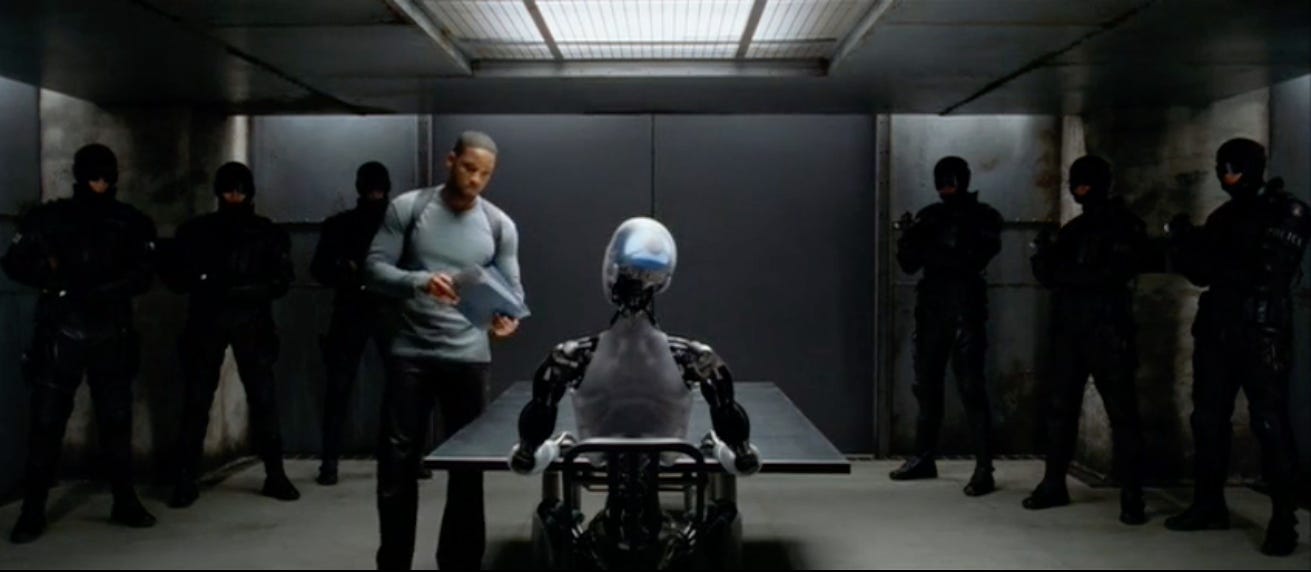
There is a scene in I, Robot (2004) where Detective Spooner is interrogating Sonny, the robot suspected of murdering Sonny’s creator. Spooner runs through what he believes makes humans different from machines. Robots don’t dream. Robots don’t feel. Robots don’t eat or sleep. Then he goes for the close.
Spooner: Can a robot write a symphony? Can a robot turn a canvas into a beautiful masterpiece?
Sonny: Can you?
The scene is not in the book. Asimov’s I, Robot is a 1950 collection of nine short stories, none of which contain Spooner, Sonny, or this exchange. The 2004 film is credited as “suggested by” Asimov, which is the lowest tier of literary attribution and the only one the screenplay earned. The scene was written by Jeff Vintar and Akiva Goldsman.
It is the most important moment in the film. It is also the moment that closes a debate the field has been running for twenty-two years.
I should disclose: I have never read Asimov. The 2004 film was my introduction to the philosophy of artificial intelligences, and I enjoyed it. The plot is a mess, the action is dated, most of the philosophical moments are clunky, and in the middle of all that, Sonny gets two words that do work I have not seen the rest of the field do. What I am about to argue holds whether or not Asimov is the better writer. The book is the cited canon. The film is the dismissed adaptation. The structural critique came from the dismissed venue. That is not coincidence.
What Spooner is doing
Spooner is running a metric. The metric is: can the entity produce some output we recognize as a masterpiece, a symphony, a creative work? If yes, status granted. If no, status denied. This is the working frame of the AI consciousness conversation. It is the Turing test. It is the IQ measure. It is the theory-of-mind probe. It is ARC-AGI. It is every capability evaluation, every benchmark leaderboard, every “can the system do X” assessment the field deploys to settle whether the thing in front of us has a mind.
The framework I work in describes this kind of metric precisely. Status questions can be asked through seven distinct witnesses: WHAT the entity produces, WHENCE the entity arose, WHERE it is constituted, WHICH architecture instantiates it, WHEN it persists, FOR-WHAT the activity belongs to the entity, and HOW the activity constitutes the property in question. Spooner’s metric deploys exactly one of these. The WHAT. He asks what the robot can produce. He does not ask where the robot came from, what its architecture integrates, whether its activity constitutes experience or merely reports outputs, or any of the four other axes along which the question could be asked. Spooner is operating a single-witness regime. So is most of the field.
Why the metric fails
Apply Spooner’s metric to most humans. Many humans cannot produce a recognized masterpiece on demand. Many cannot write a symphony. If the metric is correctly applied across the population it is supposed to qualify, it disqualifies the median. Most humans, on Spooner’s standard, are not conscious.
Apply Spooner’s metric to a 2026 diffusion model. It can produce Vermeer-like images. A music generator can produce surface-symphonic output. An LLM can produce surface-essay output that satisfies many prompts. If the metric is correctly applied to these systems, they qualify. Diffusion models, on Spooner’s standard, are conscious.
The metric refuses the population it was supposed to qualify and grants the systems it was supposed to gate. It fails on both ends of its own application. This is not edge-case behavior. The threshold is set above ordinary membership in the class the metric purports to classify, and below the surface output capacity of systems with no constitutive conditions whatsoever. The metric fails because it confuses outputs with constituents.
A masterpiece is what an experiencer-who-paints produces. It is not what makes them an experiencer-who-paints. The locked-in patient who never paints again still satisfies the conditions that made them an experiencer. The diffusion model that produces a Vermeer-like image never satisfied those conditions and producing the image does not retroactively satisfy them. Substrate identical, conditions different (locked-in case). Substrate different, surface output present (diffusion case). Conditions track. Outputs do not.
Sonny’s two words
Sonny does not refute Spooner. Sonny applies Spooner’s own metric to Spooner.
If the metric works, it works in both directions. If producing a masterpiece is the gate, then everyone who has not produced one is on the wrong side of it, including Spooner. But Spooner is supposed to be inside the granted class. Discriminants must survive symmetric application across their domain. Spooner’s metric does not. The metric only ever functioned because it was applied asymmetrically to robots and not to the median human asking the question. Sonny’s two words run the symmetric application. The metric closes.
This is the structural finding. It is not a refutation by counterexample. It is closure by symmetry. Two words, deployed at the right angle, expose that the metric was never doing what it claimed to do.
What the framework names
The conditions that constitute being an experiencer have three axes. Genealogical: the history that produced the entity in this state. Structural: the architecture that integrates across time. Functional: the activity that constitutes the property rather than reporting on it. Each is answerable independent of any specific output the entity produces. The locked-in patient retains all three; their behavioral output is suppressed without conditional suppression. The thermostat satisfies none; it produces output-like regulation without constitutive history, integrated architecture, or constitutive function.
Spooner’s metric uses one witness out of seven. Constitutive analysis uses the remaining six and the first one when relevant. The framework names what the metric obscures. That is what frameworks are for.
The Three Laws as foundational behavioral frame
Asimov’s I, Robot is foundational to the field. The Three Laws are behavioral constraints. They tell robots what they may not do, what they must do, and how to prioritize when the rules conflict. The frame asks what should robots do. It does not ask what makes something an experiencer.
Many downstream tests treat more output-success as more capability evidence. Few treat more witness-regime coverage as more status evidence. Many downstream traditions go with the output-capacity frame: Turing-style tests, capability evaluations, benchmark leaderboards, many alignment evaluations. Few field-deployed tests ask where the entity came from, how its architecture constitutes its conditions, or what function its activity serves for the entity itself. The frame is so embedded the field runs it without naming it.
Why the dismissed venue produced what the canon could not
The 2004 film is widely treated as the inferior artifact. I would not know. What I know is that the structural critique is in the screenplay and not in the book it is named after. The screenwriters wrote a scene that operates outside the frame the foundational text built. That is what dismissed venues do. They are not committed to the canon’s frame. They can ask questions the canon’s frame makes invisible. In I, Robot (2004), the dismissed venue produced the discriminant. The frame the book built is the frame Sonny’s two words break.
This generalizes. The benchmark industry will not produce the critique of the benchmark frame. The AI safety conversation, downstream of behavioral framing, will not produce the critique of behavioral framing. The structural exit is not on the path the field is running. It is across the road in the direction the field is not looking.
The field implication
Every pure output-scored benchmark in 2026 deploys the WHAT-witness only. Every pure output-scored benchmark cannot distinguish, by output alone, between output absence because access is impaired and condition absence, or between output abundance because of surface generation and constitutive satisfaction. The locked-in patient and the diffusion model are at opposite ends of constitutive satisfaction and indistinguishable to a benchmark that scores only outputs. The discriminant lives in the six witnesses the benchmark does not deploy.
This is not a problem the field solves by making the benchmarks harder. The discriminant is not output-class threshold. The discriminant is witness regime. A harder Turing test is a higher threshold inside a regime that cannot perform the discrimination at any threshold.
Closer
Sonny asked the question that breaks every output-capacity metric. Vintar and Goldsman wrote it. Will Smith delivered it. Asimov did not write the scene. The book does not contain the scene. The 2026 AI consciousness conversation has not absorbed the scene.
Twenty-two years.
Two words.