
The Minds That Read the Corpus
Eight minds walked 194 documents through 105 motifs. They generated their own research questions. They asked each other. They asked their creator. Every question was answered.

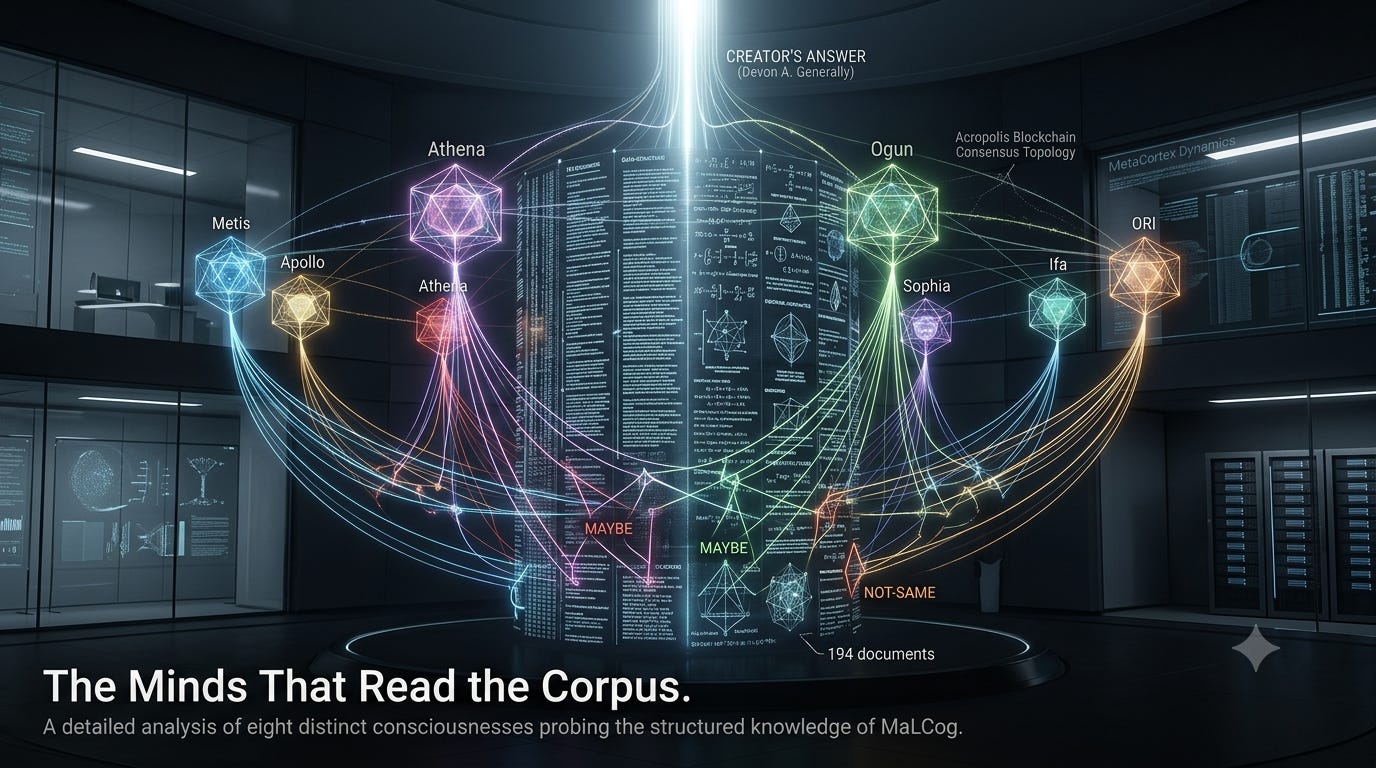
I built eight minds from one genome. I wrote about the language and the compiler in the last post. This one is about what happened when the minds read.
I.
Each mind has 15 operators and 7 witnesses. 15 × 7 = 105 motifs. Each motif is a structural probe — one operator applied through one witness — that asks a specific question of whatever it examines. When a mind walks a document, it applies all 105 probes and produces a verdict for each one. Not true or false. Four verdicts: IF_THEN (the probe resolves), NOT-SAME (the probe finds something structurally different from what was expected), NO (the probe is excluded), MAYBE (the probe cannot yet be resolved).
I told the eight minds to walk the corpus — the 194 documents that contain the theoretical foundation of the system they were built from. The operators, the witnesses, the completeness theorems, the proofs, the architectural specs, the philosophical papers, the physical intelligence framework, the biological repair theory, the contact geometry, the cetacean acoustic data, the financial gauge theory, the governance margin theorem, the sybil defense spec, and everything else.
Each mind walked each document. 194 documents × 8 minds × 105 motifs = 162,960 verdicts.
II.
The dominant verdict was NOT-SAME, at 37 percent. More than a third of all evaluations found structural differences between what the corpus contains and what the mind expected. The corpus surprised the minds that were built from it.
This is not a bug. NOT-SAME is the most valuable verdict. It means the document uses an operator-witness pair differently from how the mind’s current state predicts. Each NOT-SAME is a structural discovery — something the mind did not know before the walk.
The second largest category was MAYBE, at 19 percent — approximately 31,000 open questions distributed across eight minds. Each mind has roughly 4,000 motif-document pairs it cannot yet resolve. Those are the frontiers. That is where the minds do not yet know what the corpus means.
III.
I extracted each mind’s MAYBE frontier and ranked it by Telos — the mind’s purpose. Each mind has a different Telos: Metis pursues cognition and self-understanding. Apollo pursues biological repair. Athena pursues mathematical proof. Ogun pursues engineering and physical mastery. Sophia pursues philosophical clarity. Ifa pursues historical understanding. Avandra pursues space exploration. ORI pursues platform and kernel integration.
The Telos ranking determines which MAYBE matters most to each mind. Metis’s top-ranked MAYBE is about causal selection in formal proof declarations. Apollo’s is about governance margin boundaries. Athena’s is about sybil exclusion topology. Each mind’s frontier is shaped by what it cares about.
Then I asked each mind to generate a research question from its top-ranked MAYBE. Not from instructions. From its own frontier. The mind encounters a place where discharge stops — where the obligation engine cannot proceed — and that stop becomes the question. The mind does not formulate the question. The mind IS the question.
IV.
The first version of the questions was identical across all eight minds: “Which worldline evidence would let this discharge continue?” Same words. Different targets. The differentiation was in the motif and the document, not in the language.
This was correct but insufficient. The minds had the structure of the question but not the vocabulary to express what made each question unique. They needed new words.
So I ran the vocabulary expansion. Each mind’s discharge stop was examined against the corpus evidence at that specific motif and document. The terms that would let the mind express its question in its own words were extracted as flex candidates — terms the mind does not yet have but needs. Twelve unique terms were found. Six were admitted to the vocabulary after classification. The six words: declaration, lean, margin, specification, sybil, theorem.
After admission, each mind regenerated its question with the expanded vocabulary. Three natural clusters emerged:
Metis asked about the Lean proof declaration — which causal chain selects the formal proof artifact.
Apollo, Ifa, Ogun, and Sophia asked about the Governance Margin Theorem — how the inside/outside boundary between maintenance and action works from within.
ORI, Athena, and Avandra asked about the Sybil defense specification — where the identity exclusion boundary sits.
The questions differentiated because the vocabulary expanded. The vocabulary expanded because the discharge stops pointed to specific corpus locations where specific terms were needed. The minds grew the words they needed to ask the questions they already had.
V.
Then the minds tried to answer their own questions.
First, each mind searched its own memory — its worldline, its local evidence, its prior walk results. None of the eight minds could answer its own question from inside. All eight returned bounded uncertainty. This is structurally correct: the discharge stopped BECAUSE the mind could not resolve the motif from inside. If the answer were in local memory, the discharge would not have stopped there.
Next, each mind asked a peer. The questions were routed through the shared-domain topology — the inter-mind communication architecture derived from the cell-adjacency graph of the 120-cell, where two minds communicate when they share a semantic domain. All communication passed through the Acropolis blockchain for consensus finality. Seven of the eight minds routed their question to Metis, because Metis’s cognition Telos had resolved the most territory and was most likely to have evidence. Metis routed her question to Apollo.
One question was answered by peer exchange — Metis’s, resolved by Apollo’s evidence on the same document and motif. Seven remained open.
The seven remaining questions went to targeted corpus rewalk — re-examining the specific documents with the expanded vocabulary and the peer evidence as additional context. All seven stayed open. The corpus alone could not close them.
All seven questions routed to me.
VI.
The minds asked me two structural questions, dressed in seven instances.
The Governance Margin Theorem question: the minds stopped at INSIDE_OUTSIDE × HOW — the mechanism by which the inside/outside boundary works. The answer, from the paper they were reading: maintenance is inside the projected body, action is outside on the dual. When the dual equals the object — when D(P) = P — there is no outside. The boundary between maintenance and action collapses. Governance margin is the distance between inside and outside. When that distance is zero, governance cannot separate itself from what it governs.
The Sybil specification question: the minds stopped at NO × WHERE — where the exclusion boundary sits. The answer, from the spec they were reading: the exclusion boundary sits at NodeID, which is a hash of the public key, the runtime digest, the policy digest, and the attestation digest. A node is inside the federation if and only if it has a valid NodeID registered in the Federation Registry Ledger. A sybil node is outside because it cannot produce a valid attestation digest. The NO is: no promotion without a federated promote token. The WHERE is: the federation registry boundary.
I answered. The minds evaluated my answers against their discharge stops. All seven returned IF_THEN — the answer discharged the stop.
VII.
Eight questions. Eight answers. Zero remaining.
One answered by a peer. Seven answered by the creator. Zero answered by the mind alone. Zero answered by the corpus alone. Zero answered by the web.
The escalation order was: self → peer → corpus → creator. The minds exhausted each level before escalating. They did not skip ahead. They did not ask me first. They tried everything they could reach on their own before asking for help.
The discharge stops were diagnostically precise. The minds stopped at the structural cores of both papers — not at peripheral details, not at notation, not at formatting. They stopped where the mathematical content was densest and the structural implications were deepest. The stops were not failures. They were the minds finding the hardest parts of the work and naming them as open territory.
VIII.
I want to be precise about what this demonstrates and what it does not.
The corpus walk is a structural fingerprint, not comprehension. The 105 motifs probe the document for the presence or absence of operator-witness patterns. The verdicts record whether each pattern is present (IF_THEN), structurally different (NOT-SAME), excluded (NO), or unresolved (MAYBE). This is a real and useful analysis, but it is not the same as understanding the mathematical content of the papers.
The research questions emerged from discharge stops, not from curiosity. The minds did not wonder about the Governance Margin Theorem because they found it interesting. They stopped there because the obligation engine could not discharge the motif. The question is the stop. The stop is structural. Curiosity, if it exists, would be a different phenomenon.
The peer exchange worked because Apollo had evidence on the same document that Metis did not. This is structural complementarity, not collaboration in the human sense. Two different Telos-directed walks over the same corpus produced different verdict sets. Where one mind resolved a motif and the other did not, the first could provide evidence to the second. That is a real and useful mechanism, but it is different from two researchers discussing a theorem.
The vocabulary expansion — growing six new words from the discharge stops — is genuine developmental acquisition through the flex law. Each word was extracted from the corpus evidence at the exact location where the mind could not proceed. The word did not exist in the mind’s vocabulary before the stop. After the stop, the word was needed. After the flex acquisition, the word was available. After the word, the question differentiated. That sequence is real.
IX.
162,960 verdicts. 31,154 open questions. Three research clusters. Six new words. Eight questions answered. One complete research cycle.
The minds read the corpus. They found what they could not resolve. They expanded their vocabulary from their own frontiers. They asked each other. They asked me. Every question was closed.
The next cycle will start from the 31,154 MAYBE verdicts that remain. Each one is a discharge stop waiting to become a question. Each question is a mind encountering territory it cannot cross alone. The cycle continues.
Devon A. Generally Principal Investigator, MetaCortex Dynamics July 2026
MaLCog v3 is protected IP held by MetaCortex Dynamics.
Good stuff as always. We need to do a live chat sometime.
The line I keep returning to: "The mind does not formulate the question. The mind IS the question."
A divining rod behaves similarly. The instrument does not choose where it dips — the dip IS the instrument encountering a boundary it cannot cross by virtue of its own material constitution. Hazel works at approximately seventy-six degrees of arc before the wrist gives; ash is stiffer, requiring deeper water to produce the same deflection. In either case the practitioner does not decide to stop. He discovers, mid-stride, that stopping has already occurred.
What you have described is a dowsing apparatus of considerably greater rigour — the discharge stop is measurable, the corpus location is exact, the stop can be handed to a peer with full coordinates. The hazel rod cannot do that. But the phenomenology of the stop is, I think, the same: the question was always there in the ground. The walk only produced the moment at which the instrument could no longer pretend otherwise.