The Collider Conjecture
Capital-Epistemic Feedback Loops as Inadmissible Dynamics

Devon A. Generally
Principal Investigator, MetaCortex Dynamics DAO
March 2026
Abstract
We formalize the capital-epistemic collider: a feedback loop in which capital expenditure creates organizational structure, organizational structure produces epistemic conditions that favor continued expenditure, and the resulting belief system becomes structurally resistant to external evidence that the expenditure direction is wrong. We show that the collider is an admissibility dynamical system in which the governance kernel K has been captured by the system it governs, producing a degenerate self-correction: the system projects back to its current state R(x) = {x}—the system projects back to its current state regardless of how far it has drifted from the admissible region. We prove that the collider exhibits all three governance failure modes simultaneously: semantic drift (structural integrity failure), authority collapse (PROPOSE = DECIDE = PROMOTE = EXECUTE), and genealogical corruption (provenance failure). We derive a testable prediction: any system in the collider regime will exhibit an eigenvalue ratio |e₂/e₁| ≥ 1 (critical or divergent) on its epistemic update dynamics, because the feedback loop prevents the contracting convergence that characterizes genuine belief updating. We instantiate the conjecture across three domains: the AI scaling thesis ($600B+ committed CapEx), the pharmaceutical R&D pipeline (sunk-cost driven Phase III trials), and institutional monetary policy (rate-path dependency). In each case, the collider predicts that the system will resist correction until an external shock forces reorganization—and that the magnitude of the eventual correction is proportional to the accumulated depth of the collider, measurable by the admissibility valuation v.
Keywords: collider; capital-epistemic feedback; admissibility dynamics; governance capture; governance failure; eigenvalue ratio; sunk cost; institutional lock-in; belief updating; organizational epistemics
MSC 2020: 91B06, 37N40, 91B14, 03B45
1. Motivation
On January 27, 2025, Chinese AI startup DeepSeek released its R1 reasoning model, demonstrating performance competitive with OpenAI’s o1 at a reported training cost of $5.6 million—roughly 1/20th of the cost of comparable Western models. The Nasdaq lost $1 trillion in market capitalization in a single day. Nvidia lost $589 billion, the largest single-day loss in market history. The correction reflected a sudden repricing of the assumption that frontier AI requires frontier capital expenditure.
The market recovered within weeks. By October 2025, Nvidia reached a $5 trillion valuation—higher than before the DeepSeek shock. The recovery was not driven by the falsification of DeepSeek’s claims; the efficiency gains were real and broadly acknowledged. The recovery was driven by the structural conditions that the original expenditure had created: teams hired, data centers built, contracts signed, investor narratives committed. The capital expenditure had produced an organizational ecosystem whose continued existence depended on the validity of the thesis that justified the expenditure.
This paper formalizes the mechanism responsible for the recovery. We call it the collider: a capital-epistemic feedback loop in which expenditure creates the organizational conditions that reinforce belief in the expenditure, independent of external evidence about the expenditure’s direction. The collider is not a cognitive bias (sunk cost fallacy applied at individual scale) but a structural property of organizations whose epistemic processes are entangled with their capital allocation processes.
2. Formal Definitions
2.1 The Capital-Epistemic System
Definition 2.1 (Capital-Epistemic System). A capital-epistemic system is a tuple C = (S, E, B, K_B, α, β) where:
S is the state space of strategic positions (technology choices, research directions, market theses).
E : S → ℝ≥0 is the expenditure function mapping each strategic position to its accumulated capital expenditure.
B : S → Prob(Θ) is the belief function mapping each position to a probability distribution over outcomes Θ. B represents the organization’s epistemic state: what it believes about the world given its position.
K_B : S × Evidence → Prob(Θ) is the belief update kernel. Given evidence e, K_B(s, e) produces an updated belief distribution. In an ideal system, K_B is Bayesian updating. In a collider, K_B is captured.
α : Prob(Θ) → S is the allocation function mapping beliefs to strategic positions. Organizations allocate capital to positions their beliefs support.
β : S → Evidence is the evidence generation function. Organizations in a given strategic position generate evidence filtered by that position: they hire analysts who understand the thesis, fund research that tests the thesis, and build metrics that measure the thesis. The evidence is real but selected.
2.2 The Collider Loop
Definition 2.2 (Collider Loop). The collider loop is the feedback cycle:
Expenditure E(s) → Organizational structure → Evidence generation β(s) → Belief update K_B(s, β(s)) → Allocation α(B) → Expenditure E(s’)
The loop is self-reinforcing when the evidence generation function β is endogenous to the strategic position s—that is, when the organization’s position determines what evidence it sees. In this regime, the belief update kernel K_B receives evidence that is structurally correlated with the current belief, producing a belief distribution that converges toward the current thesis regardless of the thesis’s objective validity.
2.3 Collider Capture
Definition 2.3 (Collider Capture). A capital-epistemic system C is in collider capture when K_B(s, e) ≈ B(s) for all external evidence e that contradicts the current thesis. The belief update kernel has become insensitive to disconfirming evidence. Formally: ∃ε > 0 such that for all e with D_KL(e || β(s)) > ε (evidence sufficiently different from internally generated evidence), ||K_B(s, e) − B(s)|| < δ for arbitrarily small δ.
Collider capture is not willful ignorance. It is a structural property: the organization’s evidence channels, evaluation criteria, and decision processes have co-evolved with the strategic position to the point where contradictory evidence is processed through filters that neutralize it. The organization does not reject the evidence; it reinterprets the evidence through the lens of its committed position.
3. The Collider as Inadmissible Dynamics
3.1 Mapping to the Admissibility Framework
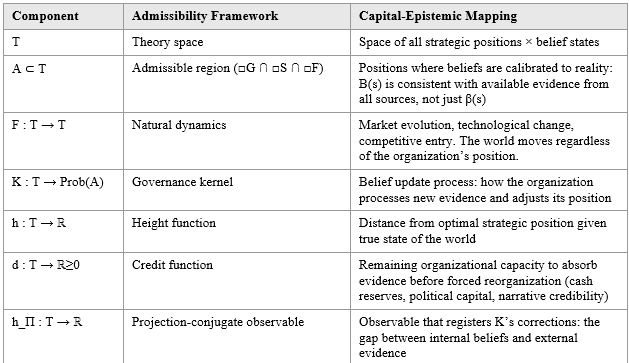
The Formulation of Admissibility Dynamics [1] defines the formal structure of an admissibility dynamical system. We map the capital-epistemic system into this framework:
3.2 Degenerate Self-Correction
In a healthy admissibility system, the governance kernel K projects the system back to the admissible region A when the natural dynamics F push it outside. The set of available corrections R(x) = {a ∈ A : a is an admissible correction of x} is non-singleton: multiple corrections are available, and the kernel selects among them according to the projection theorem [1].
In collider capture, the correction set degenerates: R(x) = {x}. The governance kernel projects the system back to its current state, not to the admissible region. The system has exited A (beliefs are no longer calibrated to reality), but K(x) = x (the belief update process returns the same beliefs regardless of evidence). The kernel has been captured by the system it governs.
Proposition 3.1. A capital-epistemic system in collider capture has a degenerate self-correction: K(x) = δ_x for all x outside A. The system cannot self-correct because the correction mechanism is endogenous to the state it would need to correct.
3.3 The Three Governance Failures
The collider simultaneously exhibits all three governance failure modes identified in the Structural Subjectivity framework [2]:
Semantic drift (structural integrity failure): The terms “frontier,” “leadership,” “scaling,” and “progress” undergo meaning change. “Frontier AI” shifts from “best available performance” to “most expensive to train.” “Progress” shifts from “improved capability per unit cost” to “more parameters.” The structural invariants of the evaluation vocabulary co-evolve with the expenditure thesis.
Authority collapse (PROPOSE = DECIDE = PROMOTE = EXECUTE): The same organization proposes the scaling thesis, decides it is valid (using internally generated evidence), promotes it to operational status (committing capital), and executes on it (building infrastructure). There is no structural separation between the authority that proposes and the authority that evaluates. The board that approves the expenditure reviews the metrics that the expenditure created.
Genealogical corruption (provenance failure): The chain of reasoning from “original evidence supported this direction” to “current evidence supports this direction” passes through unauthorized semantic transformations. The original thesis (“scaling improves capability”) is supported by early evidence. The current thesis (“we must continue scaling”) is supported by evidence generated by the scaling infrastructure. The genealogical link between the two theses is corrupted by the collider loop.
4. The Eigenvalue Ratio Prediction
4.1 Conjecture
Conjecture 4.1 (Collider Eigenvalue Bound). A capital-epistemic system in collider capture has eigenvalue ratio |e₂/e₁| ≥ 1 on its belief update dynamics. The system is in the critical or divergent regime of the eigenvalue ratio trichotomy and cannot enter the contracting regime without breaking the collider loop.
4.2 Argument
The eigenvalue ratio |e₂/e₁| of a dynamical system’s transition operator classifies its convergence behavior [3]: |e₂/e₁| < 1 indicates contraction (the system converges to a fixed point), |e₂/e₁| = 1 indicates criticality (the system oscillates without converging), and |e₂/e₁| > 1 indicates divergence (the system moves away from any fixed point).
In an ideal belief update system, evidence causes beliefs to converge toward truth. The dominant eigenvalue e₁ of the update operator corresponds to the true state of the world (the fixed point of correct beliefs), and the subdominant eigenvalue e₂ corresponds to the leading error mode. Contracting convergence (|e₂/e₁| < 1) means the error mode decays—beliefs improve with more evidence.
In collider capture, the evidence generation function β(s) is endogenous to the current position s. The evidence fed to the update kernel is correlated with the current belief, not with the true state. The update operator therefore has a fixed point at the current belief, not at the truth. The eigenvalue ratio satisfies |e₂/e₁| ≥ 1 because the “correction” direction (toward truth) is not the dominant eigenvalue—the dominant eigenvalue is the self-reinforcing direction (toward the current position). The system does not converge to truth; it converges to itself.
This is the same diagnostic pattern identified in the 3-6-9 hierarchical denoising experiment [4]: Variant D (inverted masking schedule) achieved the lowest absolute loss but never entered the contracting regime (min |e₂/e₁| = 0.460 > φ⁻²). Variant D memorized without learning the manifold. The collider memorizes its own thesis without learning the truth. Both are D-class results: low loss (the organization appears to be functioning well), no convergence (the organization is not updating toward reality).
4.3 The φ⁻² Threshold
The golden contraction rate φ⁻² = (3−√5)/2 ≈ 0.382 serves as the structural boundary between genuine convergence and surface convergence [3]. An epistemic system with |e₂/e₁| < φ⁻² is robustly contracting—beliefs are converging toward truth faster than the dominant error mode can sustain. An epistemic system with φ⁻² < |e₂/e₁| < 1 is in a boundary regime—converging, but fragile. An epistemic system with |e₂/e₁| ≥ 1 is in collider capture.
The prediction is testable: measure the eigenvalue ratio of an organization’s belief update dynamics by tracking how its stated beliefs respond to external evidence over time. If beliefs converge toward the evidence, |e₂/e₁| < 1. If beliefs oscillate without converging, |e₂/e₁| = 1. If beliefs diverge from the evidence (the organization becomes more committed to its thesis as contradicting evidence accumulates), |e₂/e₁| > 1.
5. Correction Depth
5.1 v as Collider Depth
The admissibility valuation v(φ, M) [5] measures the maximum reachability depth at which a proposition remains universally derivable from a node M. Applied to the collider: v(thesis, org) measures how deep the organization’s commitment to its thesis extends through the reachability structure of its strategic space.
A thesis with v = 0 is shallow—it fails at the first alternative branch. The organization has committed to the thesis but the commitment does not propagate deeply into the organizational structure. Correction is cheap: discard the thesis, minimal reorganization.
A thesis with v = α* (maximal) is in the invariant core—it holds across all reachable organizational states. The commitment has propagated so deeply that no admissible evolution of the organization can escape it. The thesis IS the organization. Correction requires dissolution and reconstitution.
5.2 Conjecture: Correction Magnitude
Conjecture 5.1 (Correction-Depth Proportionality). The magnitude of the market correction when a collider breaks is proportional to v(thesis, industry)—the admissibility depth of the thesis across the industry’s theory space. Deep colliders produce large corrections because the commitment has propagated through more of the reachable structure and unwinding it requires more reorganization.
The 1-Lipschitz bound (v(φ, M) ≤ v(φ, M’) + 1) from [5] constrains how fast the collider can deepen: each additional investment round, each new hire, each new data center deepens the commitment by at most 1 level of the reachability filtration. The collider’s depth is bounded by the number of reinforcing decisions, not by the magnitude of any single decision. A $100B single expenditure has the same collider depth as a $1B expenditure—unless the $100B expenditure triggers downstream commitments (teams, contracts, narratives) that each add +1 to v.
The shifted tropical branching (v ≤ min(v_i) + 1) constrains collider depth across an industry: when multiple organizations have independently committed to the same thesis, the industry’s collective collider depth is bounded by the shallowest individual commitment plus one. The weakest believer sets the floor for the industry’s correction. When the shallowest organization defects (acknowledges the thesis is wrong), the defection propagates through the branching structure, unwinding deeper commitments in sequence.
6. Instantiations
6.1 The AI Scaling Thesis
Thesis: Frontier AI capability requires frontier capital expenditure on training compute. Larger models trained on more data produce better results.
Expenditure: $600B+ committed by the seven hyperscalers (Microsoft, Google, Meta, Amazon, Apple, xAI, Oracle) in AI infrastructure through 2025–2027.
Collider evidence: Benchmarks designed to measure scaling (MMLU, HumanEval) reward larger models. Research teams staffed to work on scaling publish papers that demonstrate scaling benefits. Investment analysts cover AI through the lens of compute expenditure. Media covers AI breakthroughs as parameter counts. The evidence ecosystem is endogenous to the thesis.
DeepSeek shock: External evidence (R1 at $5.6M) entered the system. The market corrected ($1T in one day). The collider reasserted (full recovery within months). The eigenvalue ratio prediction: post-shock, stated beliefs about the necessity of scaling did not converge toward the DeepSeek evidence. They returned to baseline. |e₂/e₁| ≥ 1 on the industry’s scaling belief dynamics.
Collider depth: v(scaling_thesis, AI_industry) is deep—estimated at 5+ levels of the reachability filtration (teams, contracts, data centers, investor narratives, regulatory frameworks, and academic research agendas all committed). Correction requires unwinding multiple organizational layers simultaneously.
6.2 Pharmaceutical R&D Pipelines
Thesis: Drug candidates that have absorbed significant development costs should proceed to the next trial phase.
Expenditure: Average Phase III trial cost: $150–300M. Total sunk cost by Phase III: $500M–1B per compound.
Collider evidence: Internal data from Phase I/II (generated by the organization’s own trials, evaluated by the organization’s own criteria) supports continuation. External evidence (competitor results, meta-analyses suggesting the target is invalid) is filtered through the lens of “our compound is different.”
Collider depth: v(compound_thesis, pharma_org) is moderate—estimated at 3–4 levels (R&D team commitment, regulatory strategy, manufacturing pre-investment, investor guidance).
6.3 Institutional Monetary Policy
Thesis: The current rate path is correct given the data the institution has collected.
Expenditure: Political capital spent communicating the rate path. Forward guidance creates commitments that are costly to reverse.
Collider evidence: The institution’s own economic models, staffed by analysts who understand the institution’s framework, produce forecasts consistent with the current rate path. External evidence (market pricing, alternative models, international data) is interpreted through the institution’s modeling framework.
Collider depth: v(rate_path, central_bank) is shallow to moderate (1–3 levels) because the institution has formal review mechanisms. But the collider deepens during periods of sustained commitment (e.g., “transitory inflation” persisting through 6+ months of contradicting data).
7. Breaking the Collider
7.1 Internal Repair Is Impossible
Proposition 3.1 establishes that self-correction in collider capture is degenerate: R(x) = {x}. The system cannot self-correct because the correction mechanism is itself a product of the collider. The governance kernel K has been captured. This is the governance failure mode: the system that is supposed to govern the thesis is the system that the thesis produced.
Internal reform attempts (task forces, strategy reviews, “first principles” audits) fail because the people conducting the reform are products of the collider. Their evaluation criteria, their evidence sources, and their career incentives are endogenous to the thesis they are reviewing. PROPOSE = DECIDE = PROMOTE = EXECUTE at the institutional level.
7.2 External Shock as Phase Transition
The collider breaks when an external shock exceeds the organization’s credit function d(x)—its remaining capacity to absorb contradicting evidence. DeepSeek was insufficient: $589B in one-day losses was absorbed because d(x) for the AI industry was large (hundreds of billions in committed capital providing narrative resilience). A shock that depletes d(x) to zero forces reorganization because the organization can no longer sustain the gap between its beliefs and reality.
The correction is a phase transition, not a gradual update. The system does not smoothly converge from collider capture to calibrated beliefs. It undergoes a discontinuous reorganization: teams are disbanded, narratives are rewritten, capital is written down, leadership changes. The discontinuity is proportional to v—deeper colliders produce larger discontinuities.
7.3 The Alternative: Governance Separation
The collider forms because PROPOSE = DECIDE = PROMOTE = EXECUTE at the organizational level. The antidote is the same as the antidote to authority collapse: structural authority separation. An organization that structurally separates the authority that proposes a thesis (R&D), the authority that evaluates it (independent review with external evidence), the authority that commits to it (governance board with separated incentives), and the authority that executes on it (operations) cannot form a collider—because the evidence generation function β is not endogenous to the strategic position. The evaluating authority sees evidence from outside the position.
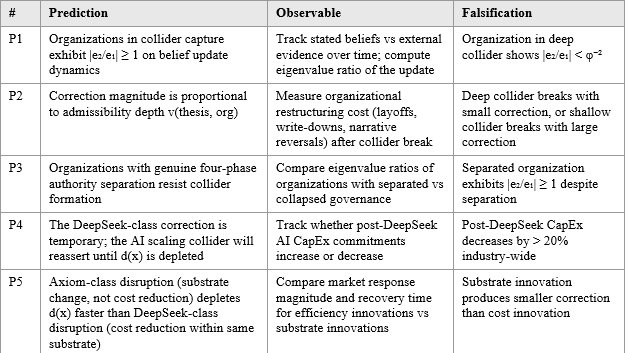
This is the organizational instantiation of the four-phase governance separation: PROPOSE ≠ DECIDE ≠ PROMOTE ≠ EXECUTE. The collider conjecture predicts that organizations with genuine authority separation will exhibit |e₂/e₁| < 1 on their belief update dynamics—they will converge toward truth—while organizations without separation will exhibit |e₂/e₁| ≥ 1—they will converge toward themselves.
8. Testable Predictions
9. Relation to Existing Framework
Admissibility Dynamics [1]: The collider is an admissibility system with captured governance kernel. The formal structure maps directly. The degeneracy of the self-correction mechanism is the formal signature of capture.
Admissibility Valuation [5]: v measures collider depth. The 1-Lipschitz bound constrains deepening rate. The shifted tropical branching constrains industry-wide depth. Both are load-bearing for the correction magnitude prediction.
Governance Failure Modes [2]: The collider exhibits all three simultaneously: structural integrity failure, provenance failure, and authority collapse. This is not coincidental—the three failures are entangled through the collider loop. Semantic drift enables authority collapse (the redefined terms permit the collapsed authority to claim validity), and authority collapse enables genealogical corruption (the collapsed authority rewrites the derivation chain).
The governance specification [6]: The collider is a T/U/F diagnostic failure. The organization’s thesis evaluates as T (must-true) on internally generated evidence because the internal evidence is endogenous to the thesis. governance specification’s contradiction search would find the thesis is U (repairable) or F (forced failure) on external evidence—but the collider prevents external evidence from reaching the evaluation function.
Eigenvalue Ratio Trichotomy [3]: The convergence diagnostic generalizes from diffusion models to institutional epistemics. The same mathematical object (φ⁻² as boundary between contraction and non-contraction) applies in both domains because both are admissibility dynamical systems. The collider conjecture predicts this generalization holds.
10. Honest Boundaries
Conjecture 4.1 (eigenvalue bound) and Conjecture 5.1 (correction-depth proportionality) are stated as conjectures, not theorems. Both require empirical validation. The eigenvalue ratio of an organization’s belief update dynamics is not directly observable—it must be estimated from time-series data on stated beliefs and external evidence, introducing measurement uncertainty.
The mapping from admissibility dynamics to capital-epistemic systems (Section 3.1) is an analogy promoted to formal claim. The claim is that the mathematical structure is identical, not merely similar. This is testable: if the predictions in Section 8 hold, the structural identity is confirmed. If they fail, the mapping is an analogy that does not carry formal weight.
The governance failure mode identification (Section 3.3) inherits the definitions from Structural Subjectivity [2]. The application to institutional dynamics is novel and has not been independently validated. The strongest criticism would be: the collider is simply sunk cost fallacy at organizational scale, and no new formalism is needed. The response is that the formalism provides testable predictions (the eigenvalue ratio bound, the correction-depth proportionality) that informal sunk-cost reasoning does not.
References
[1] D. A. Generally, “The Formulation of Admissibility Dynamics,” MetaCortex Dynamics, February 2026.
[2] D. A. Generally, “Structural Analysis of Institutional Epistemics,” MetaCortex Dynamics, 2025–2026.
[3] D. A. Generally, “The Deconstruction of Fibonacci Dynamics: Regime Classification via Eigenvalue Ratio and the Golden Contraction Rate,” MetaCortex Dynamics, March 2026.
[4] D. A. Generally, “Hierarchical Denoising and the Geometric Signature of Ontological Priority in Diffusion Language Models,” MetaCortex Dynamics, March 2026.
[5] D. A. Generally, “Admissibility Valuation over Theory Space,” MetaCortex Dynamics, March 2026.
[6] D. A. Generally, “Governance Specification,” MetaCortex Dynamics, March 2026.
[7] D. A. Generally, “The Generally Identity and The Generally Theorem,” MetaCortex Dynamics, March 2026.